Getting Back to Ithaca
About an obscure new art-house movie called The Odyssey.

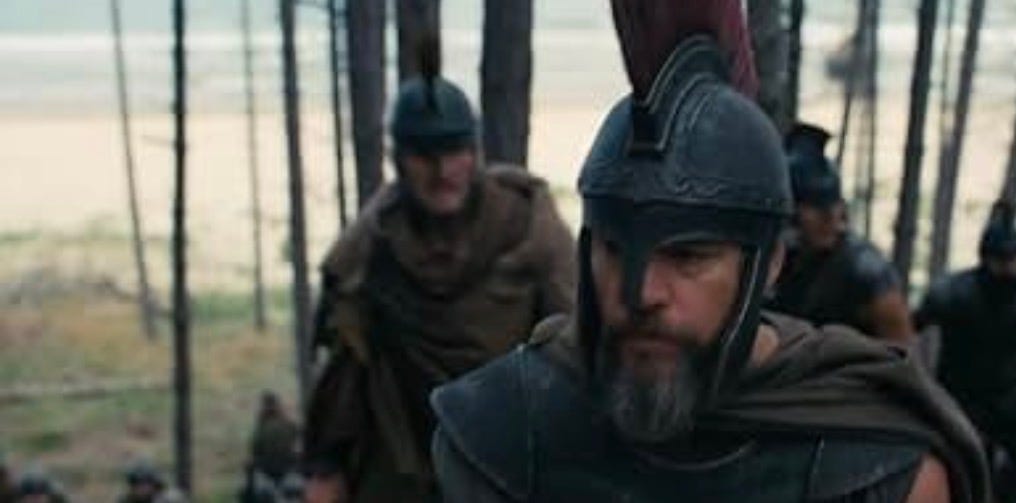
Near the end of his life, George Orwell wrote, “At 50, everyone has the face he deserves.” That is one reason to stop looking at reflecting pools. But I was thinking about Orwell’s quote in the lead-up to the new movie version of The Odyssey, because every era gets the Odyssey it deserves.
Like the stories of Jesus and Moses, the tale of Odysseus never really goes away. There is something both eternal and adaptable about it. Any sentient human being who’s lived long enough feels they’ve been past whirlpools and through the legs of the Cyclops, when not being waylaid by lotus-eaters and almost turned into a pig.
When Alexander Pope translated Homer’s poem in 1726, he turned it into an Enlightenment tale of manners (buzz kill!). James Joyce took the bones of the thing and melted them into the surreal consciousness streams of Ulysses. Robert Fitzgerald and Richmond Lattimore brought a battle-weary Odysseus home a couple of decades after World War II. Robert Fagles added Technicolor splashes in 1996. And Emily Wilson, while casting feminist aspersions on her predecessors, gave us a very 21st century – and commercially successful – translation in 2017.
So why shouldn’t Christopher Nolan do a movie version? The previous film adaptations haven’t set the world on its ear. There was a shlocky Kirk Douglas flick in 1955, a 1968 European TV miniseries that few saw, and a 1997 American TV version with Armand Assante and The Return in 2024 with Ralph Fiennes as a sinewy, bedraggled Odysseus taking on Penelope’s suitors. Spongebob Square Pants and the Coen brothers also borrowed from Homer. So why not Matt Damon and Anne Hathaway?
I haven’t always been a fan of Nolan’s films. I first liked the tricky labyrinth of Memento, but ultimately found it empty. The Dark Knight movies left me cold. I couldn’t make head or tail out of Interstellar and Inception. Dunkirk and Oppenheimer were finally about something, but not definitive.
The time is right for a new Odyssey. A lot of us feel like we’ve been through the fall of Troy over the past few years. Foundational values have crumbled. Our ship has gotten lost and the crew members are at each other’s throats. The one thing that many on the right and many on the left might agree is that we need to get back to Ithaca. We need to go home and find a place where we can at least exist in peace – even if some of us don’t want to co-exist with anyone who is different from us.
Nolan’s film acknowledges that yearning. A number of the characters in the film give voice to the idea that our world is badly broken. Zeus’s Law has been shattered by man’s war, honor has been betrayed, nature itself has turned against us. But Nolan’s world is not Homer’s world. It can’t be. The ancient Greeks’ view of life makes no sense to a mass modern audience. The presence of the gods in our daily lives, shaping our fates and judging our adherence to xenia – the ancient code of hospitality - would be box office poison.
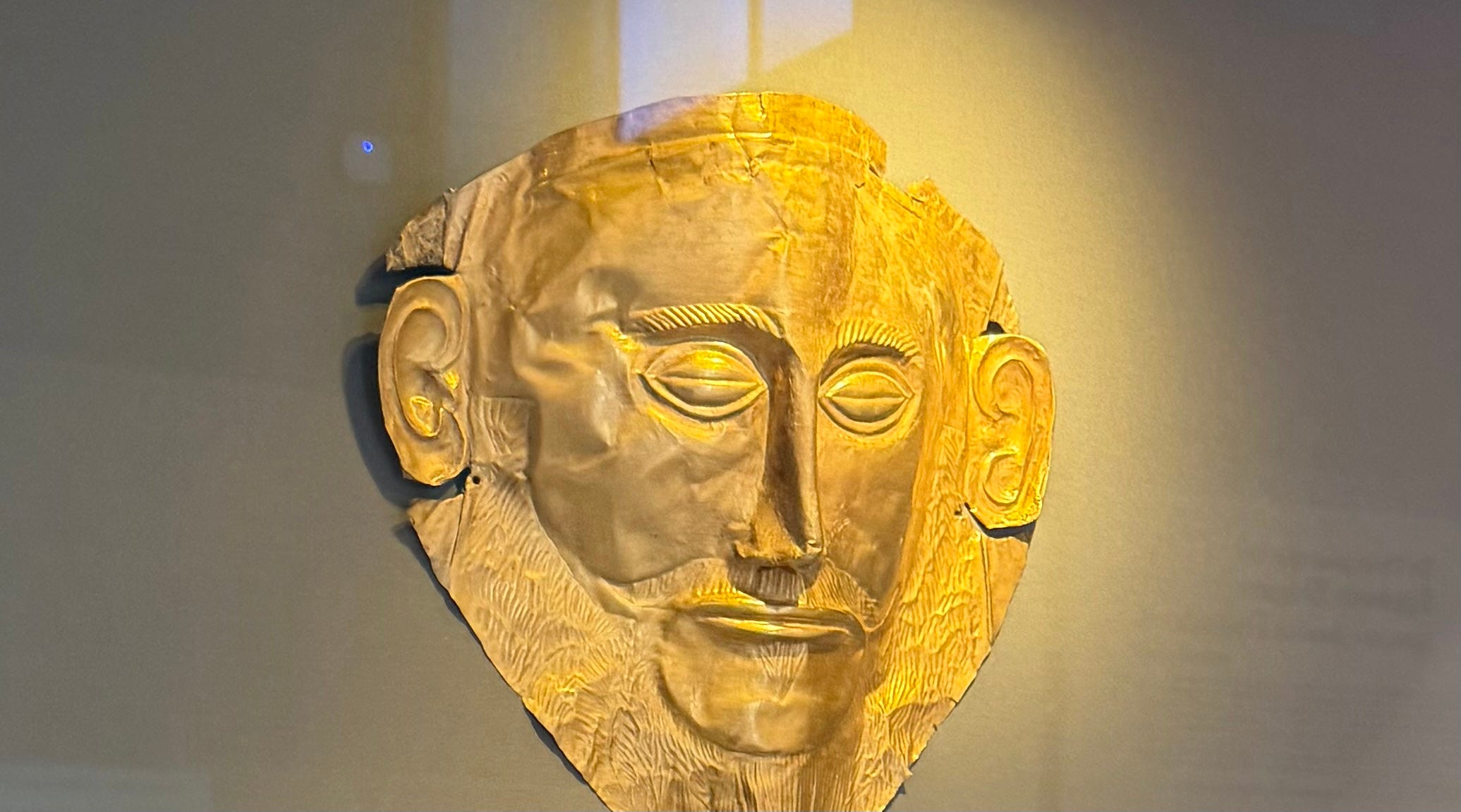
Instead, Nolan and his collaborators have given us an odyssey that’s heading somewhere else. As others have noted, Matt Damon plays Odysseus as a kind of hard-working, conscience-stricken Everyman, not the man “of twists and turns” per the Fagles translation. I wondered if the script reflects the influence of Damon, a very intelligent man who has made good intelligent movies, in an era where intelligence is treated with increasing hostility. Damon’s Odysseus is a war general suffering from post-traumatic stress and torturing himself over not just the deaths of his comrades, but over atrocities he took part in during the sacking of Troy.
It’s a powerful notion, likely derived from books like Odysseus in America: Combat Trauma and The Trials of Homecoming by Dr. Jonathan Shay. Shay, a psychiatrist who has treated many Vietnam war veterans, wrote eloquently and compassionately about the crippling effects “moral injury,” the distress experienced by soldiers who have been forced to violate their personal ethical codes. Those feelings of guilt, shame, and betrayal are familiar to any modern person who isn’t a sociopath. But they would not be recognizable to Homer or his listeners in the ancient world.
But so what? Pope’s Odysseus wasn’t exactly Homer’s and neither is Emily Wilson’s. The new movie gives us a “relatable” Odysseus and a visual rendering of his narrative that’s nearly the equivalent of Homer’s words. We get eye-popping versions of the Cyclops, Circe turning soldiers into pigs, golden-limbed Charlize Theron as Kalyso, and the Trojan Horse stuck in sand like the Statue of Liberty at the end of Planet of the Apes. As a cinematic updating of a story from antiquity, Nolan’s film is hard to beat. The controversy over the “woke” casting of the Black actress Lupita Nyong’o as Helen of Troy and the transgender actor Elliot Page as the Greek soldier Sinon are no big deal; both of them are fine and not in the film that much.
But the movie’s version of Odysseus runs straight into a thematic incoherence at the end. Our hero is supposedly so tortured by memories of the Trojan that he spends seven years getting addicted to memory-erasing lotus leaves on an island with Kalypso (yeah, right, that’s why you’d delay rushing back to pissed-off Anne Hathaway). But then he comes back to Ithaca and unleashes an unholy slaughter of Penelope’s suitors that’s presented as cathartic and restorative.
The filmmakers know there’s a contradiction here. After telling us to be horrified by the fate of one young Trojan woman in a flashback, they avoid talking about what famously happened to the slave girls Odysseus found sleeping with the suitors. In Homer’s version, Odysseus tells his son Telemachus to take them outside and hang them. Here is how Emily Wilson translates it: “their heads all in a row, / were strung up with the noose around their necks / to make their death an agony. They gasped, / feet twitching for a while, but not for long.”
You can understand why that scene might not appeal to audiences who enjoy Love Island. But then instead of returning to the throne and setting his house in order, Nolan’s Odysseus departs from Homer’s text with his queen and sails off for “the west,” a communion with the dead, while their son Telemachus is left to clean up his parents’ mess and somehow reunite a kingdom in shambles.
So we never really get back to Ithaca and the restored world. Instead, a wounded (dying?) Odysseus tells Penelope that their story will be sung “Because songs will be all they have to remember those of us who could write.”
I guess Nolan is referring to the collapse of the Bronze Age and the beginning of the Dark Age when writing disappeared for hundreds of years, anticipating we’re headed toward that kind of dimness in our era. I hope he’s not right. But sometimes I fear he is.
But maybe the best thing about Nolan’s Odyssey is that it’s sending people back to the original. Emily Wilson’s translation hit number 3 on the Amazon bestseller list after the film’s release and earlier versions are sailing briskly as well.
So when I walked out of the theater, I didn’t think about whether Odysseus was dying or even how well the movie is doing at the box office. I remembered the beggar who used to sit outside my local supermarket like one of Homer’s sages, calling out to passing children, “don’t forget to read a book.”
Such clarifying observations. Thanks. I kind of expect to be partly cloudy from (about} a Nolan film too. This helps.
As I mentioned, I am probably teaching this in the fall, and I am looking forward to the rebirth of reading as well. I took my goddaughter to see it, and she immediately returned home to take my copy of the latest version. It is going to be a thing. I did not wander during the 2hrs and 50mins of the film. Nice job.